
Deconsecration: The Space of Memory/The Memory of Spaces
13 January – 28 February
Salisbury Arts Centre, Bedwin Street, Salisbury, SP1 3UT.
Artists: Francesca Lazzarini and Maria Francesca Tassi
Curated by Sara Falanga
www.salisburyartcentre.co.uk
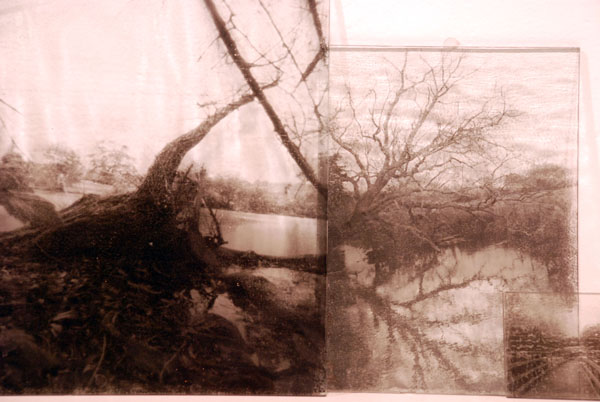
F.Lazzarini, Aleph series, 2011, photograph on glass

M.F. Tassi, The Creation, spolvero, paper
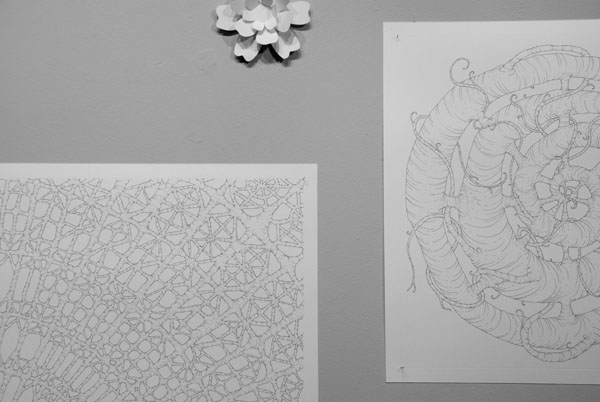
M.F.Tassi, Pondering possibilities, 2011, china ink on paper
*******
In the deconsecrated 13th century St. Edmund’s Church, where Salisbury Arts Centre is housed, this exhibition traces what links the place’s past to the present, narrating the shift from church to arts centre. It emphasizes the coexistence of old and new elements, in a context that across time has remained a meeting place for the Salisbury community. Visitors will confront the mechanisms of vision and memory in an immersive site-specific installation, and will be led to reflect on Deconsecration as act of transposition from place dedicated to worship to one dedicated to the arts.
Francesca Lazzarini (1978, Italy) presents an interactive installation consisting of a giant Camera Obscura, where people can discover the enchantment of the light outside projecting an upside down image of the external environment. The work is an invitation to reflect on our own vision of the ancient church as contemporary art centre. It confronts us with the mechanism of our seeing, perceiving and remembering, becoming itself a metaphor of the memory’s locus: the mind. Lazzarini also presents pinhole photographic works, a technique producing an optical effect very close to human sight. She offers her own vision of the venue, emphasized by the unusual use of glass as photographic printing surface, a nod to the stained glass windows of the church.
Maria Francesca Tassi (1977, Italy) creates drawings using the spolvero technique over the modern white walls within the church, suggestive of typical decorative practices used to realize frescoes since the medieval period, but adopting modern themes peculiar to the building’s new employment. Some paper sculptures complete the installation in a unique and continuous dialogue with the singular hosting environment. These works tell what the building preserves of its ancient function mixed up with elements belonging to the modern art centre, they tie the old to the new through fragile and temporary materials, which trace softly what the building shows: the memory of its space.
The exhibition will be completed by an online archive of collected images and anecdotes from the venue’s history, contributed by local residents, who are invited to bring personal photographs and found images of the church across the decades to a Memory Amnesty on Saturday 14th January.

